
We provide OEM products and services ranging from the simplest 2D camera to the most advanced solutions embedded in a SmartCamera or combined with the Scorpion 3D Stinger Camera.
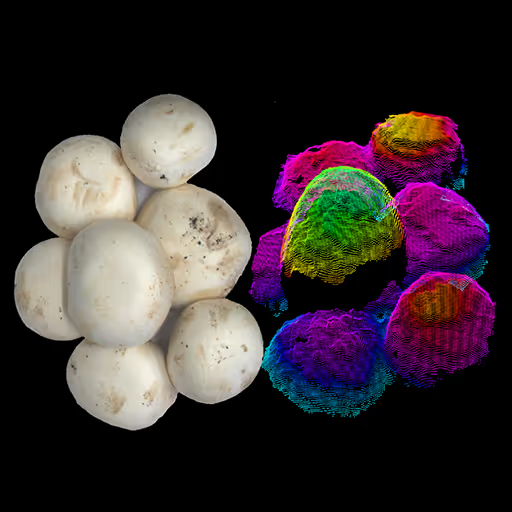
In industrial automation, success is rarely about theory. It comes down to whether a system can perform, consistently and efficiently, under real production conditions
That is the space where Tordivel’s OEM solutions operate.
With decades of experience across both research and industry, Tordivel works closely with OEMs to design machine vision systems that are not only technically capable, but practical to deploy and scale. These systems are built to integrate directly into production environments, where precision, efficiency, and cost-effectiveness are not optional, they are fundamental.
At the core of every solution is Scorpion Vision Software®. Its strength lies in adaptability. Rather than locking systems into rigid configurations, it allows engineers to build, adjust, and extend functionality over time. For OEMs, this reduces development complexity and ensures that systems remain relevant as production requirements evolve.
In applications where depth and spatial understanding are critical, Tordivel also develops custom 3D vision solutions. These systems provide real-time measurement and analysis, supporting everything from inline inspection to advanced robotic guidance.
The industries involved are diverse, aquaculture, food and beverage, automotive, aluminium, logistics, but the underlying challenge is the same: delivering reliable performance in demanding environments.
In that sense, Tordivel operates less as a vendor and more as a partner, working alongside OEMs to create systems that are robust, scalable, and built for long-term use.
Food production is one of the most challenging environments for automation.
Products vary naturally. Conditions change constantly. And yet, the expectation remains the same: consistent quality, delivered at high speed.
Tordivel’s approach to food inspection is shaped by that reality. Its systems are designed to perform reliably regardless of variation in product size, shape, or presentation, maintaining accuracy even as line speeds increase.
In practice, this means supporting a wide range of tasks. Systems can sort products by colour and shape, detect defects, guide robotic handling, and verify packaging and assembly. Each of these functions contributes to a broader outcome: improved product quality, reduced waste, and greater confidence in the production process.
The challenge becomes more complex when dealing with fresh or live products. Unlike manufactured items, they do not conform to fixed specifications. This is where Tordivel’s combination of Scorpion Vision Software® and advanced 3D technologies becomes essential.
Systems such as the Scorpion 3D Stinger allow machines to interpret natural variation in real time, adapting to differences rather than rejecting them. This capability is particularly important in applications like automated fish vaccination, where precise identification and positioning are required to locate injection points safely and accurately.
What emerges is a shift from simple inspection to something more capable: systems that can understand products as they actually are, not as they were expected to be.
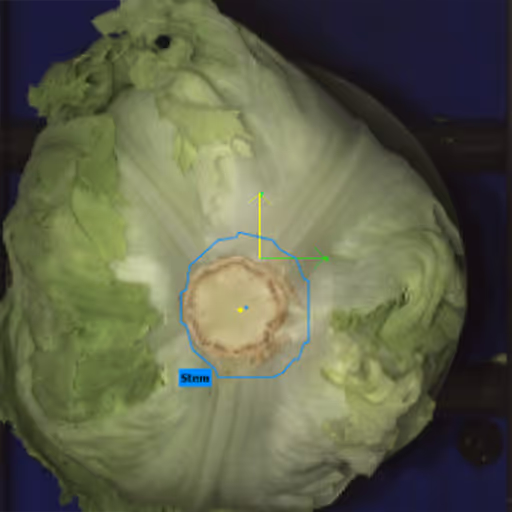
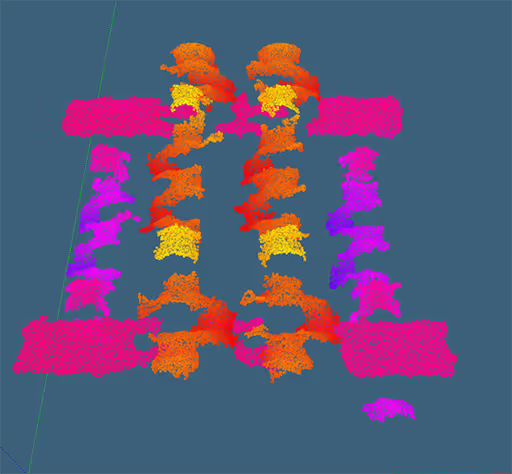
One of the most persistent challenges in automation is handling objects that are not neatly arranged.
In controlled environments, robots perform well. But introduce variation, objects in random positions, overlapping, or arriving unpredictably, and the problem becomes far more complex.
Tordivel’s 3D robot vision systems are designed to operate in exactly these conditions.
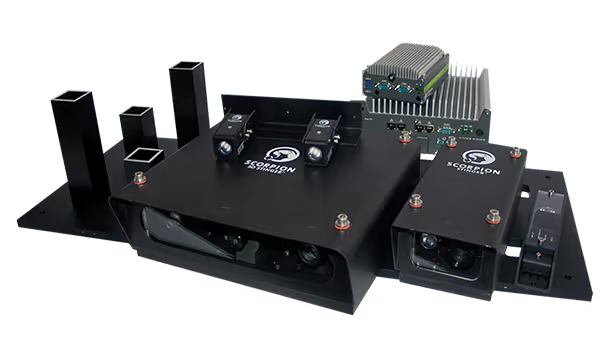
Built around Scorpion Vision Software® and the Scorpion 3D Stinger, these systems generate accurate, real-time 3D data. This allows robots to identify objects, determine their position and orientation, and execute precise pick-and-place operations, even in cluttered or unstructured environments.
A typical setup is straightforward in principle: a 3D camera positioned above the workspace or mounted on a robot, connected to an industrial PC running the vision software. The complexity lies in the processing. The system continuously interprets spatial data and communicates with robots using standard industrial interfaces, ensuring compatibility across platforms.
What distinguishes this approach is flexibility. Instead of requiring carefully controlled inputs, the system adapts to variation. Objects can arrive in bins, on conveyors, or in mixed configurations, and still be handled reliably.
This makes it suitable for applications such as:
The effect is a subtle but important shift. Rather than forcing the environment to suit the machine, the machine adapts to the environment, reducing manual intervention, simplifying system design, and improving overall efficiency.
Scorpion 3D Stinger™ captures images, identifies and locates the product and sends the id and 3D location to a picking robot.
Traditional machine vision systems rely on rules. Neural systems rely on learning.
Tordivel’s 3D Neural Massflow Food Sorter brings that distinction into a real production context, combining 3D imaging, colour grading, and neural network decision-making into a single, integrated system.
Recognised as a Silver Honouree at the 2022 Vision Systems Design Innovators Awards, the system reflects a broader shift in how food processing automation is approached, not as a fixed set of instructions, but as a system capable of adapting to variation.
At its core, the sorter integrates a Foodsafe 3D Colour Scanner with Scorpion’s neural robot vision technology. This enables simultaneous analysis of shape, surface condition, and colour, all in real time.
Mass flow environments are particularly demanding. Products move continuously, often unpredictably, and rarely conform to uniform standards. Instead of relying on rigid rules, the system uses neural models to interpret variation, learning to handle differences in size, texture, and appearance.
There is also a practical advantage in how the system is built. Optical components, including projectors and illumination, are fully integrated into a compact unit. This reduces installation complexity and improves reliability, particularly in harsh, washdown environments.
The benefits are immediate:
But the more important shift is conceptual. By combining inspection with decision-making and robotic action, the system moves beyond sorting. It creates a continuous process where machines actively interpret and respond to what they see.

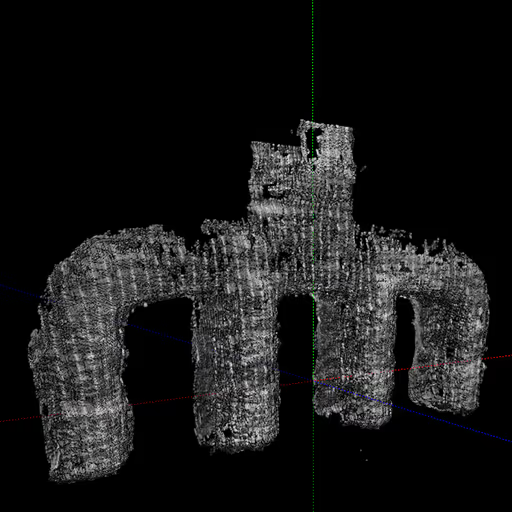
Aluminium production presents a different kind of challenge for automation.
The environment is harsh. The materials are heavy. And the tolerances are tight. Small inaccuracies can lead to significant inefficiencies, or worse, operational risks.
Tordivel has been working in this space for nearly two decades, beginning with early developments in inline 3D stub alignment in 2005. Since then, its systems have been deployed in large-scale operations such as Hydro’s plant in Sunndal and Qatalum in Qatar, facilities where reliability is critical.
The core challenge is positioning.
In aluminium smelting, the precise alignment of anodes and stubs directly affects process efficiency, product quality, and safety. Traditional automation methods struggle in this environment, largely due to the combination of heat, dust, and mechanical complexity.
Tordivel’s solution is based on non-contact, real-time 3D measurement. Using systems built on the Scorpion 3D Stinger, it becomes possible to detect, measure, and adjust positioning without physical interaction.
These systems can:
The result is consistent, repeatable alignment, even in environments where traditional sensing methods fail.
As aluminium producers continue to push for higher efficiency, lower emissions, and safer operations, this kind of intelligent automation becomes increasingly important. Tordivel’s role is to provide the precision and reliability required to make that transition possible.
Some automation problems cannot be solved with rules alone.
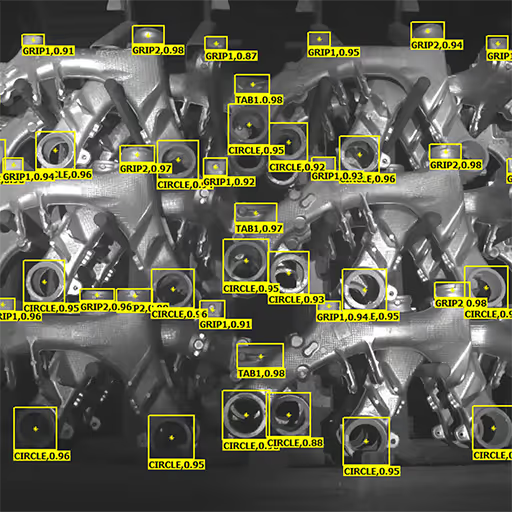
When variation becomes too great, when objects overlap, change shape, or appear unpredictably, systems need to interpret, not just detect.
Tordivel’s Realtime 3D Neural Robot Vision is designed for exactly these situations. It combines stereo-based 3D imaging with neural network processing to create systems that are both flexible and robust.
The process begins with 3D perception. Stereo vision generates accurate spatial data, capturing both the position and orientation of objects. This data is then processed using neural models, allowing the system to identify and localise objects even in complex or cluttered environments.
By combining geometry with learned behaviour, the system can:
Compared to traditional rule-based systems, this approach reduces setup complexity and improves long-term stability. There is less need for manual tuning, and the system adapts more naturally to changes in production conditions.
The system also operates in real time, delivering low-latency data to industrial robots via standard interfaces such as TCP/IP. This enables seamless integration and immediate response during operation.
Typical outputs include:
In addition to guiding robots, the system supports detailed assembly verification, detecting missing or incorrectly placed components and validating complex geometries.
The result is a system that scales with complexity, remaining reliable even as variation increases.
Speak to our engineers about your project requirements. We provide end-to-end support from concept to installation.

Call us

Email us

Head Office (Norway)

Advanced machine vision automation solutions for a smarter, more efficient industrial future.


