
Industrial automation has long depended on vision systems to guide, inspect, and sort, but the quality of machine perception has always imposed a ceiling on what automation can reliably achieve. Standard 2D imaging captures shape and colour well enough for simple, controlled tasks.
The moment a process introduces variability (irregular surfaces, reflective materials, objects presented at unpredictable angles), the limitations of conventional vision become operational constraints. Our latest development in 3D stereo vision addresses precisely this class of problem, not by refining existing approaches at the margins, but by combining three distinct technologies into a single, coherent system that raises the threshold of what automated perception can credibly handle.
Three Technologies, One Integrated System
At the heart of our new approach is the integration of high-resolution industrial cameras, infrared Random Pattern Projection (RPP) lasers, and advanced neural networks. Each element is well understood in isolation. The significance here lies in how they function together.
High-resolution industrial cameras provide the foundational image data, detailed, accurate, and consistent across varying lighting conditions. This matters because resolution directly limits the smallest defect or positional deviation a system can detect. In applications such as pharmaceutical packaging inspection or precision component sorting, the difference between adequate and genuinely high-resolution imaging is measurable in the quality of decisions made downstream.
The infrared RPP lasers introduce structured depth information. Rather than relying on ambient light or simple geometric models, Random Pattern Projection works by casting a complex, irregular infrared pattern across a scene and analysing the way that pattern deforms across surfaces. The result is a dense 3D point cloud, a spatial map of the environment, that remains reliable even on surfaces that would typically confound depth sensing: featureless textures, specular materials, soft or deformable objects. What this means in practice is that the system can generate accurate depth data across a far wider range of real-world materials than conventional approaches allow.
The neural network layer then operates on this combined stream of high-resolution imagery and detailed 3D geometry. Rather than applying fixed rules to known shapes, the network learns from data, enabling it to handle the kind of variability that rule-based systems struggle with. The effect is a processing pipeline that approaches complex decisions (object classification, defect identification, pose estimation) with a degree of adaptive intelligence that scales with the difficulty of the task.
Why This Combination Changes the Practical Equation
Each of these three technologies individually improves on what came before. Their integration is what makes this development genuinely significant. Consider a mixed-pallet depalletising application: individual items may vary in shape, orientation, reflectivity, and surface texture. A 2D system may struggle with depth ambiguity; a structured light system without high-resolution imaging may miss surface defects; a neural network operating on low-quality input data will produce unreliable outputs regardless of its sophistication. Our approach removes the weakest link from each scenario by addressing resolution, depth fidelity, and intelligent processing simultaneously.
This matters equally at the extremes of the application spectrum. In food handling, where hygiene requirements are strict, surfaces are often irregular, and gentle manipulation is critical, the system's ability to generate reliable 3D data on soft or featureless objects is directly relevant to operational performance. In heavy industrial automation, where component tolerances are tight and misidentification carries significant downstream cost, the combination of resolution and depth precision provides the accuracy margin that demanding processes require
The Broader Architecture: Software, Hardware, and AI as a Service
Our technical contribution extends beyond the vision hardware itself. Since 2003, we have built a complete stack around our core imaging expertise, and this new 3D stereo capability sits within that broader ecosystem.
Scorpion Vision Software forms the software foundation, a platform designed for industrial deployment, flexible enough to accommodate a wide range of application requirements without demanding bespoke development for each integration. Alongside this, our Neural Edge Computers bring AI processing to the point of capture, reducing latency and avoiding the bandwidth and reliability risks associated with cloud-dependent architectures. For time-sensitive applications, real-time guidance, inline quality control, on-site processing is not a convenience but a functional requirement.
Perhaps the most operationally significant offering for organisations without large in-house AI teams is our Neural Network as a Service model. Rather than requiring customers to develop and train their own models from scratch, this service provides access to trained, application-specific AI models that can be deployed from the outset. The practical effect is a material reduction in the time and expertise required to move from system installation to reliable, production-ready performance.
Precision as an Operational Asset
There is a tendency in industrial technology to treat precision as a specification on a data sheet, something measured in benchmarks and demonstrated in controlled conditions. What our integrated approach makes clear is that precision, when built coherently across hardware, software, and AI, becomes an operational asset. It reduces reject rates, supports tighter process control, simplifies the handling of variable inputs, and ultimately extends the range of tasks that automation can perform with genuine reliability.
As manufacturing and logistics environments continue to introduce greater product variety, shorter production runs, and higher quality expectations, the ceiling imposed by conventional vision systems becomes a more pressing constraint. Systems that can perceive with genuine depth and intelligence, and that arrive as integrated, deployable solutions rather than collections of components requiring extensive configuration, represent a meaningful step forward in what automated processes can be asked to do.
Our new 3D stereo vision system is one such step. Its significance lies not in any single technology, but in the deliberate coherence of the whole.
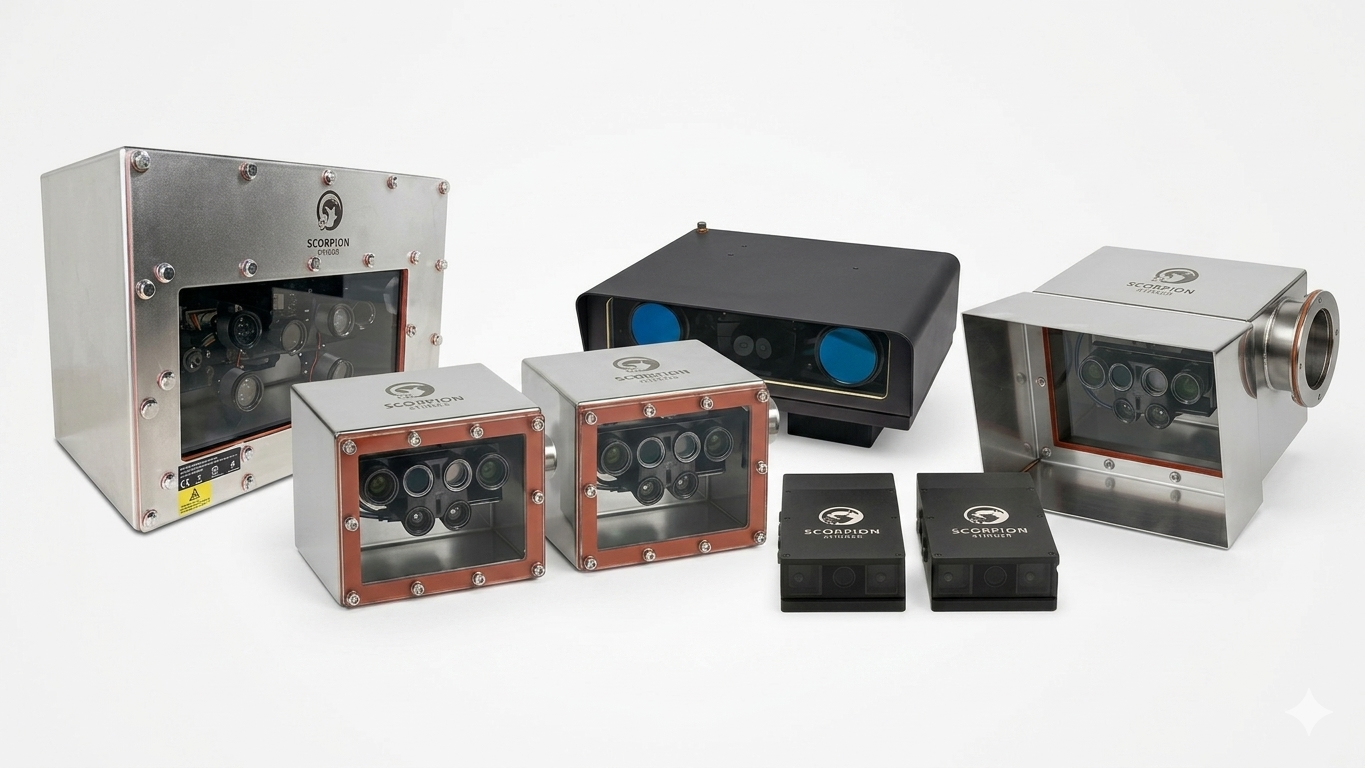
Scorpion 2D and 3D Stinger™ Cameras


