Machine vision has spent the better part of three decades earning the right to be trusted with production decisions. Every calibration routine, every metrology check, every millisecond of deterministic processing exists because a line cannot afford to guess. Into this world of hard-won reliability, artificial intelligence has arrived promising speed, flexibility and a faster route from concept to deployment; qualities that industrial vision has traditionally treated with some caution.
At VISION 2026 in Stuttgart, Tordivel AS is presenting its answer to that tension: Scorpion Vision AI, a way of bringing AI-assisted development into an industrial vision platform without asking the production line to trust anything new.
A platform built for trust, now built for speed
Scorpion Vision has been running production applications for more than twenty years, and its reputation rests on a simple premise: the same input produces the same output, every time, under conditions that can be measured, tested and audited. That discipline has never been optional. What has changed is how engineers build, test and maintain the applications that sit on top of it. Scorpion Vision AI does not alter what Scorpion Vision does on a live line. It changes how quickly and how confidently engineers (and, increasingly, AI agents working alongside them) can develop, validate and support the vision applications that run there.
What Scorpion Vision AI actually changes
At its core, Scorpion Vision AI rests on three design decisions. The first is that the deterministic engine itself stays exactly as it was: calibration, metrology and real-time processing behave identically whether or not AI tools are involved in building the application around them. The second is openness. Scorpion Vision's built-in Python environment, a feature of the platform for two decades, already let engineers draw on the wider open-source ecosystem (image processing libraries, AI inference frameworks, 3D processing, data analysis) as reusable components rather than reinventing them from scratch. Scorpion Vision AI extends that openness to AI agents themselves.
The third decision is connectivity, and it is the one most likely to change daily practice. A new interface, built on the Model Context Protocol, exposes more than four hundred Scorpion Vision methods in a structured, controlled way. What this means in practice is that an AI agent can inspect a live application, check its calibration, retrieve results, compare test runs and draft a report; all without ever taking control of the production decision itself. That distinction matters more than it might first appear.
Why the deterministic core was never up for negotiation
The actual pass or fail, the actual measurement, the actual coordinate handed to a robot; these continue to be produced by a tested, versioned, deterministic Scorpion Vision profile running at the edge. AI assists the engineering work around that profile: building components, testing them against real image sets, comparing performance across versions, documenting what changed and why. Nothing is deployed to a live line without a human reviewing and approving it first. As Thor Vollset, CEO of Tordivel AS, puts it: "The objective is not to replace deterministic machine vision. It is to make the development, testing, deployment and long-term maintenance of advanced vision systems substantially faster and more accessible." Python has underpinned Scorpion Vision for more than twenty years; the MCP interface is best understood as the next step in that lineage, rather than a departure from it.
Three ways of working, one underlying discipline
Not every task on a production floor needs an engineer at a screen, and Scorpion Vision AI is structured around that reality. In interactive use, an engineer prompts, inspects, configures and tests, with the platform handling the repetitive groundwork. In agent-assisted use, a set of agents works across multiple sites in the background: reading logs, checking image sets, preparing fixes, flagging anything irregular before it becomes a support call. In fully automatic use, reports and alarms generate themselves from the same live context that drives the vision process, so deviations reach the right person with the supporting evidence already attached. Across all three modes, real-time image processing never leaves the edge; only the supervision and reporting layer scales outward.
A new camera to demonstrate the point
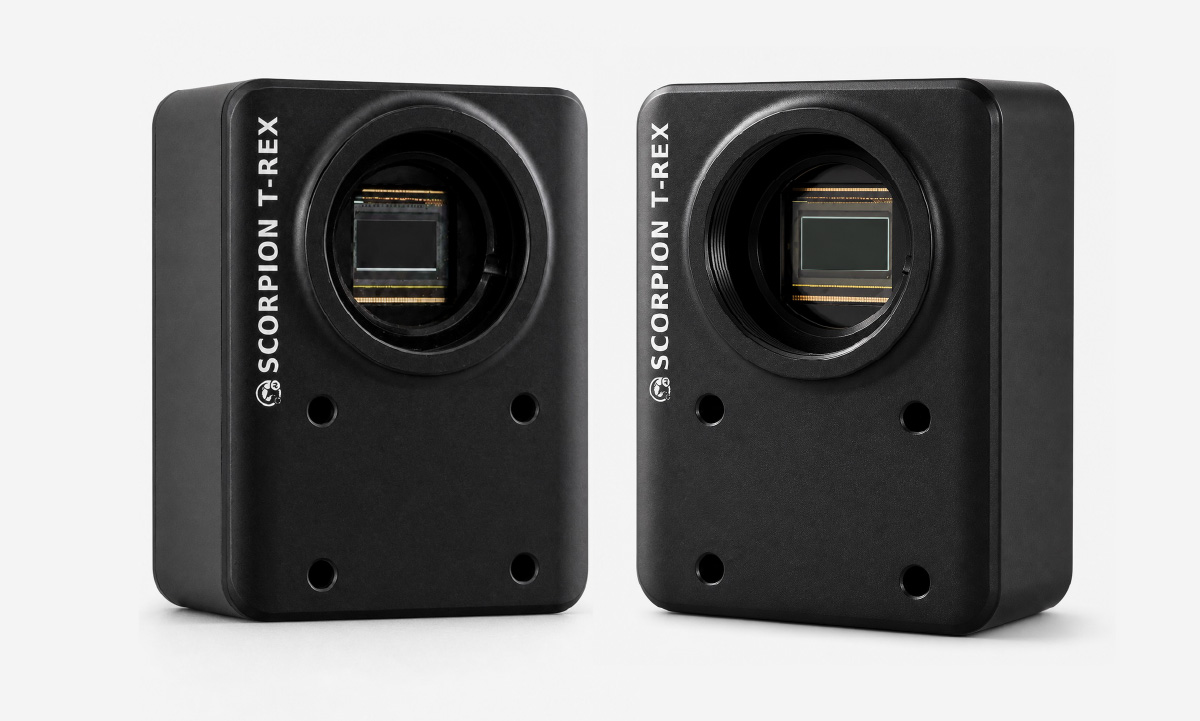
Alongside the software, Tordivel is introducing the Scorpion T-Rex 4K SH EVO, a compact FPGA smart camera built around a 9-megapixel global shutter sensor capable of up to 290 FPS at full frame and up to 3600 FPS at reduced ROI.
In practical terms, that speed and shutter type mean fast-moving parts (cans on a filling line, parcels on a belt, components in a robot cell) are captured sharp and undistorted, with none of the motion smear or rolling-shutter artefacts that cheaper sensors introduce. A Xilinx FPGA system-on-chip onboard allows image processing to begin on the camera itself, reducing latency and network load on lines running many cameras, and the range scales from 5 to 25 megapixels on a shared platform, so the same architecture serves both fast code reading and high-resolution 3D inspection.
Built around the customer, not the other way round
Tordivel's approach to OEM partners follows the same logic as the platform itself: start from what the application actually requires, then configure the sensor, housing, enclosure and Python components around it, rather than asking the customer to fit a fixed specification. That collaboration typically begins at the R&D stage and continues well beyond the first deployment, because the same Scorpion T-Rex, SMARTedge and Scorpion Vision AI stack that inspects a washdown bottling line one month can be reconfigured for high-speed parcel scanning the next. The aim is long-term technical partnership, backed by continued investment in the platform, rather than a single transaction.
Stuttgart, and what comes after
Scorpion Vision AI has been running quietly in real installations since Easter 2026. VISION 2026, running 6-8 October in Hall 10, Stand 10H75, is where Tordivel shows it properly for the first time, running live alongside the new Scorpion T-Rex camera. The broader point extends beyond any single show: as AI tools move deeper into industrial engineering, the platforms that succeed will be the ones that make development faster without asking production floors to compromise on the certainty they have always required.