The economics of pelagic fish processing leave little room for inefficiency. When herring and mackerel move through a facility at industrial volumes, every sorting decision, made thousands of times per shift, determines product quality, yield accuracy, and downstream value.
For decades, mechanical systems have handled this task adequately, but not always precisely. The gap between adequate and precise is where optical sorting technology is beginning to make its mark.
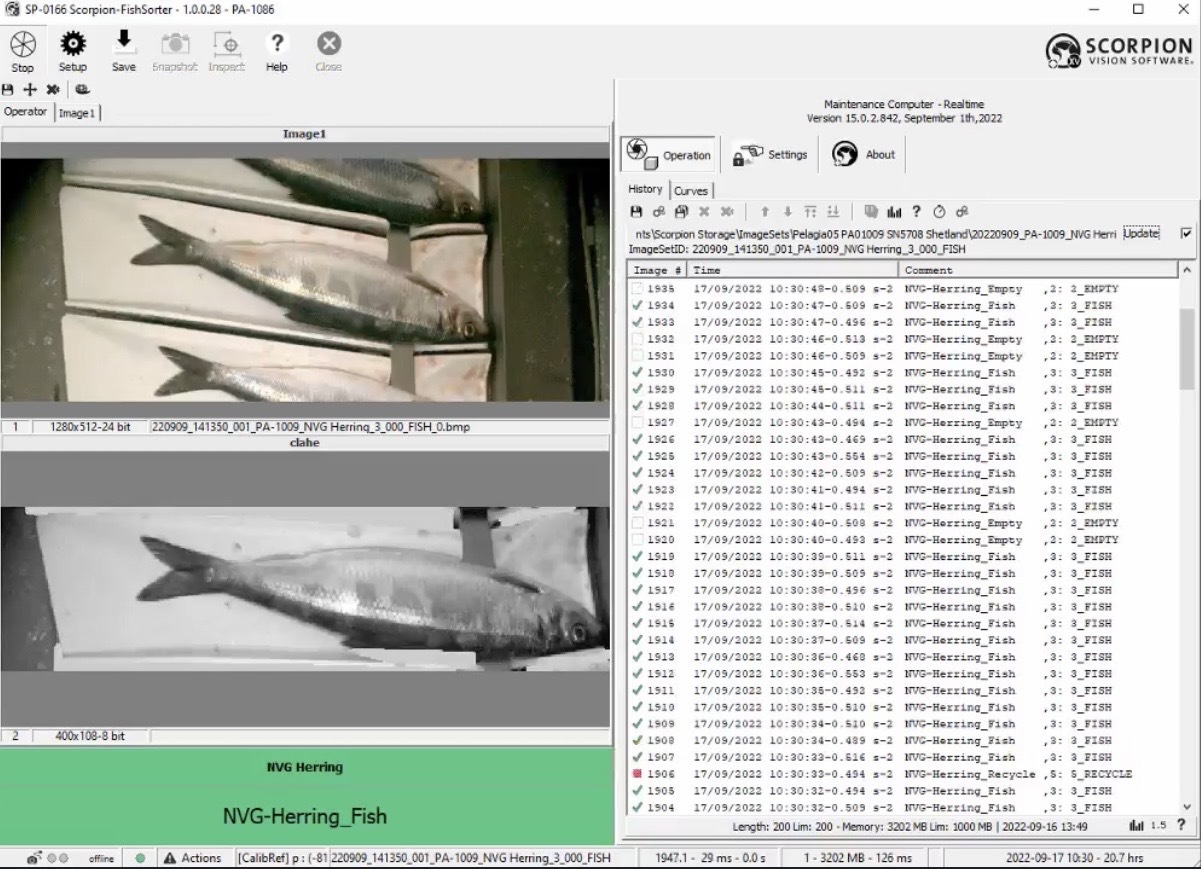
We have developed an automatic optical sorting system for pelagic species that addresses this gap directly. Designed to handle herring and mackerel at rates of 200 to 300 fish per minute, the system is built for the realities of high-throughput processing environments, and is available both as an OEM integration and as a drop-in upgrade for the Baader 221, one of the most widely deployed platforms in the sector.
A Foundation Built in the Water
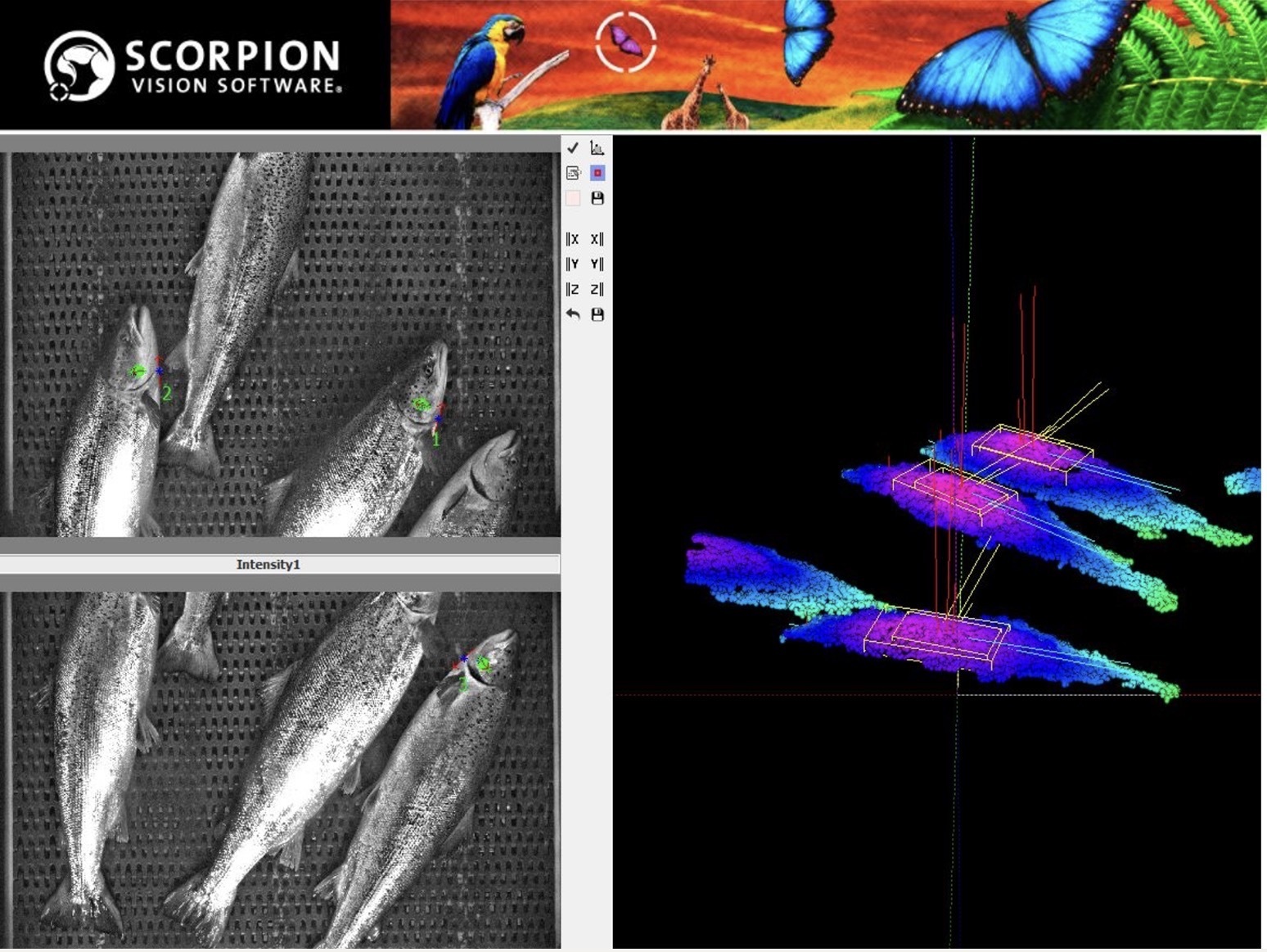
Our entry into fish processing was not opportunistic. We have been applying optical measurement to aquaculture since 2007, initially developing systems to measure breeder fish and salmon on conveyor lines. That early work established something that matters enormously in industrial vision systems: a genuine understanding of how biological material behaves under measurement conditions; how light interacts with wet, reflective surfaces, how size and shape vary within a species, and how to build algorithms that remain consistent under the variability inherent in living organisms.
From 2019, we extended that knowledge base into salmon sorting for vaccination programmes, adding defect detection and wound identification to its capability set. This progression, from measurement to classification to defect analysis, reflects a deliberate accumulation of expertise rather than a rapid pivot to follow market demand. The result is a technology stack developed entirely in-house, in Norway, and refined across years of operational deployment.
What Optical Sorting Changes on the Line
The Baader 221 has served the pelagic processing industry reliably for many years. What optical upgrading adds is not a replacement of mechanical competence, but a meaningful extension of it. Rather than sorting solely by physical interaction (weight, resistance, dimension estimated through contact), the system makes sorting decisions based on what it actually sees.
At its core, the platform uses machine vision to assess each fish as an individual. Size, shape, and visual characteristics are captured and evaluated in real time, with the system making classification decisions before the fish reaches the next stage of the line. What this means in practice is greater consistency across a shift: the system does not fatigue, does not vary its assessment criteria between the first hour and the eighth, and does not require recalibration when an operator changes.
At 200 to 300 fish per minute, the throughput is sufficient for serious commercial operation. The speed is not a compromise, it is a design parameter that has been validated in deployment, not modelled in a laboratory.
Drop-In Compatibility and the Value of Minimal Disruption
For processing facilities already operating Baader 221 equipment, the case for optical upgrading hinges significantly on integration. A system that requires substantial line redesign, extended downtime, or retraining across the workforce introduces friction that can erode its own business case. Our drop-in configuration addresses this directly.
The ability to retrofit an existing platform matters because processing facilities are not clean-sheet installations. They are working environments with established layouts, validated workflows, and capital equipment that carries years of remaining service life. An upgrade that slots into the existing architecture, preserving the mechanical structure whilst adding optical intelligence above it, allows operators to improve sorting performance without restarting from zero.
For OEM customers and system integrators, the platform offers similar advantages: a proven optical sorting capability that can be incorporated into broader processing line designs without requiring the development of proprietary vision technology from scratch.
Salmon Technology Informing Pelagic Application
One of the less obvious strengths of our pelagic system is what it inherits from our salmon work. The challenges of sorting salmon, particularly for vaccination, where fish must be classified by size within narrow tolerance bands at high speed, are in many respects more demanding than pelagic sorting. The fish are heavier, the defect categories are more complex, and the downstream consequences of misclassification are more significant.
The AI models developed for salmon wound and defect detection, the 2D and 3D measurement capabilities, and the inline Salmofan colour measurement systems represent a level of analytical sophistication that exceeds what pelagic sorting has historically required. The effect is a pelagic system that carries engineering headroom, built on a more demanding technical foundation than its current application strictly requires. For customers considering longer-term capability expansion, this is not an incidental detail.
Measurement as a Competitive Variable
The broader significance of optical sorting in pelagic processing is not simply operational. As traceability requirements tighten across European and export markets, and as buyers place increasing value on grading consistency, the ability to demonstrate objective, measurable sorting criteria becomes commercially meaningful. A facility that can show its grading is based on real-time optical assessment, consistent across every fish, every shift, every batch, is in a different conversation with its customers than one relying on manual judgement or purely mechanical classification.
Our system offers a precise, reliable, and practically deployable tool for one of the most repetitive and consequential decisions on the line. In an industry where margins are measured carefully and consistency compounds over time, that is a game-changing contribution.